
Key takeaways
- A lawsuit cash advance usually costs more than a personal loan, a credit card or a loan from family, and the gap grows the longer your case stays open.
- Banks charged an average of 11.90% a year on two-year personal loans and 22.36% on credit cards in August 2026, while customers in one large study of advances paid about 43% a year.
- An advance is the only one of the four with no monthly payments and nothing owed if your case brings in no money, and that is the main reason it costs more.
- The cheaper choices work only if you can make monthly payments now and could still repay the money if you lost your case.
When an injury stops your paycheck, the bills keep coming. A lawsuit cash advance is one way to cover them, and it is usually the most expensive way. This guide compares it with three other places people turn: a personal loan, a credit card and family.
If advances are new to you, start with our guide to what a lawsuit cash advance is.
What it costs to borrow $5,000
Say you need $5,000 to cover rent and bills while your case is open, and it takes two years to pay back. The chart below shows what each option costs on top of the $5,000. The longer the bar, the more you pay. Gray bars are the bank loan and the credit card. Blue bars are lawsuit cash advances at a low, typical and high rate. A family loan with no interest costs nothing, so it has no bar.
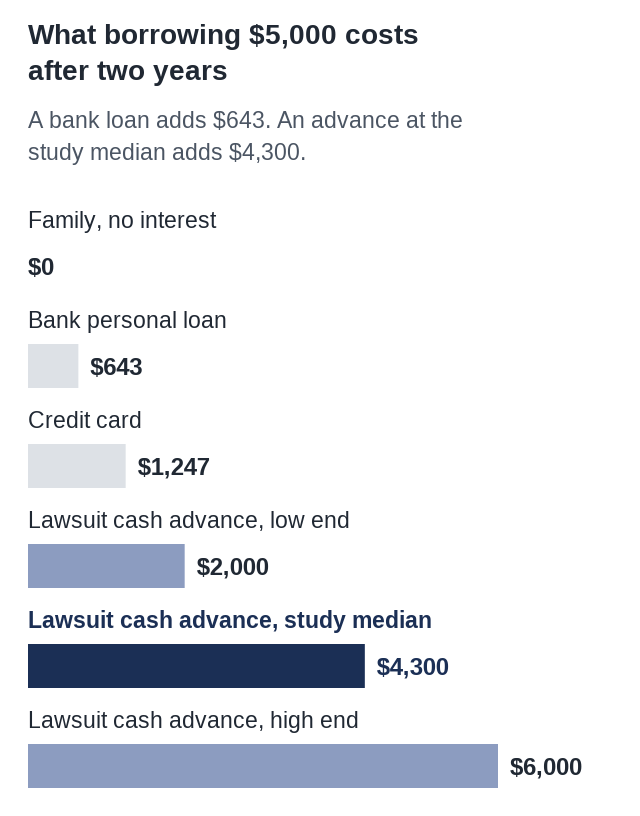
A bank personal loan adds $643 over two years, and a credit card adds $1,247. A lawsuit cash advance adds $2,000 to $6,000, depending on the company. At the 43% a year that customers paid in one large study, it adds $4,300, almost seven times the cost of the bank loan. A loan from family can cost nothing.
The gap comes from how each one is repaid. You pay down a loan or a card every month, so the interest is charged on a balance that keeps shrinking. An advance charges on the full $5,000 the whole time, because you pay nothing until your case ends. That is why an advance at 20% a year still costs more than a credit card at 22.36%.
The table below adds what each option costs if the money is out for one year instead of two. In the 12-month column, the loan and the card are paid off in 12 monthly payments, about $444 a month for the loan and $469 for the card. The advance is simply repaid a year sooner.
| Where the money comes from | Yearly rate | Cost after 12 months | Cost after 24 months |
|---|---|---|---|
| Family, no interest | 0% | $0 | $0 |
| Bank personal loan | 11.90% | $328 | $643 |
| Credit card | 22.36% | $626 | $1,247 |
| Lawsuit cash advance, low end | 20% | $1,000 | $2,000 |
| Lawsuit cash advance, study median | 43% | $2,150 | $4,300 |
| Lawsuit cash advance, high end | 60% | $3,000 | $6,000 |
A shorter wait cuts each cost about in half, but the order stays the same. Even at its low end, an advance costs more than a bank loan or a credit card over the same time.
Here is where the numbers come from:
- The loan and the card. The rates are the Federal Reserve's averages for August 2026, the latest month it has published. The card rate is the average for accounts that were charged interest. Both rows assume equal monthly payments, about $235 a month for the two-year loan and $260 a month for the card.
- The advance. You pay nothing until the case ends, then everything at once. The low and high ends come from Nolo, which reports that advances cost between 20% and 60% a year. The middle row comes from a study of about 112,000 funding cases at one large company. There, the typical advance was $2,250 and the typical payback was $3,380, which works out to about 43% a year.
- What the advance rows leave out. They are examples, not quotes, and they use a simple yearly charge. Most contracts in that study compounded monthly, which costs more the longer a case runs. Our guide to comparing offers shows how much more.
An advance costs more because the company takes the risk
With a loan or a credit card, the risk is yours. You owe the money whether you win or lose your case.
With an advance, much of the risk moves to the company. If New York's Litigation Funding Act covers your advance, you owe nothing when your case brings in no money, unless you break an important term of the contract or commit fraud against the company. You also make no payments until the case is over and your lawyer has received the money.
That risk is real for the company. In the same study, it got nothing back in 10% of finished cases.
Our guide to your rights under New York's law explains these protections and who they cover.
How the four compare
| Lawsuit cash advance | Personal loan | Credit card | Family | |
|---|---|---|---|---|
| What approval depends on | Your case | Your credit and income | Your credit limit | Your relationship |
| Monthly payments | None until the case ends | Yes, starting right away | Yes, at least the minimum | Whatever you agree |
| If you lose your case | You owe nothing | You still owe all of it | You still owe all of it | You still owe it unless they forgive it |
| New York's limit on cost | The advance plus 25% of your total recovery | 16% or 25% a year for lenders that are not banks | None for most cards | None |
New York's limits work differently for each one. A lender without a state license can charge up to 16% a year on personal loans of $25,000 or less, and a licensed lender can charge up to 25%. Those limits do not apply to most banks and credit cards, because of federal law. The funding law sets no yearly rate at all. It limits the total a company can collect.
Which one fits your situation
- You can make monthly payments. A family loan or a personal loan will cost far less than an advance. Put a family loan in writing, with the amount and the date you will repay it.
- You can't make payments, or couldn't repay if you lost. This is the situation an advance is built for. Take the smallest amount that solves the problem, because the cost grows every month.
- The gap is small and short. A credit card you can pay down in a few months may cost less than an advance you carry for two years.
- You aren't sure a bank will approve you. The Federal Reserve's average is what banks charged the people they approved. If you are out of work or have little credit history, you may be quoted a higher rate or turned down. Get a real quote before you count on a loan.
- You get SSI. Money you must repay no matter what, such as a bank loan or a written family loan, does not count as income. An advance may be treated differently, so read our guide to advances and benefits first.
Time is what makes an advance expensive, so ask your lawyer how long your case is likely to take. See also SettleScore's guide to how long a personal injury settlement takes in New York.
Check for cheaper help first
Before you borrow from anyone, check whether no-fault insurance or workers' compensation already covers part of your lost pay. Our guide to cheaper options and side effects explains both.
If an advance still fits, compare funders side by side and run your own numbers in the funding cost calculator.
This article is general information, not legal or financial advice for your situation.
Sources: Federal Reserve, Consumer Credit (G.19), November 6, 2026 release · Ronen Avraham and Anthony Sebok, An Empirical Investigation of Third Party Consumer Litigant Funding, 104 Cornell Law Review 1133 (2019) · Nolo, Is a Pre-Settlement Loan a Good Idea for Cash-Strapped Injury Claimants? · New York Attorney General, Payday loans · Social Security Administration, Spotlight on Loans · New York Financial Services Law § 1003 · § 1004 · § 1005. Dollar figures in the chart and the first table were calculated by CompareFunders from the stated rates.