
Key takeaways
- If your case brings in no money, you owe the funding company nothing under New York's Litigation Funding Act, and you keep the advance you already received.
- If your case settles for less than expected, the company is paid only from what is left after your lawyer's fee, case costs and paybacks such as Medicare's.
- A low settlement can still use up your whole share, and in our example a $10,000 advance takes everything left from a $20,000 settlement.
- The protection does not apply if you break an important term of the contract or commit fraud against the company, or if the law does not cover your advance.
A lawsuit cash advance is repaid from your case. So what happens if the case doesn't go the way your lawyer expects? The answer depends on whether your case brings in nothing, or just less than you hoped.
The rules in this guide apply when New York's Litigation Funding Act covers your advance. Our guide to your rights under New York's law explains who the law covers. If it doesn't, for example because you live in another state, your contract decides what you owe (see "When the protection does not apply" below).
If your case brings in no money, you owe nothing
You do not repay the advance, and you owe no charges on it. Every contract the law covers must say so in bold capital letters inside a box: the charges are paid only from the money your case brings in, and only to the extent that money is available.
It does not matter how the case ends without money. The other side can win at trial, a judge can dismiss the case, or a win can be reversed on appeal. A company can require payment only after the case is finally resolved, any appeals are over, and your lawyer has actually received the money.
This is not rare. In a study of about 112,000 funding cases at one large company, the company got nothing back in 10% of finished cases.
If your case settles low, three limits apply
The company is paid the lowest of three amounts:
- What your contract says you owe on the day your case pays out.
- New York's limit, which is the advance plus 25% of your total recovery, measured before your lawyer's fee and costs. A smaller settlement means a smaller limit.
- What is actually left. Your lawyer's fee and case costs are paid ahead of the company. So are Medicare and other paybacks that a law requires. The company cannot require you to pay more than what your case has available.
Take a $10,000 advance that has grown to a $17,200 payoff after two years. The chart below shows where the money goes if the case settles for $100,000, $40,000, $30,000 or $20,000. Each bar is one settlement. The light gray part pays your lawyer's fee and case costs, the darker gray part pays the funding company, and the navy part is your check.
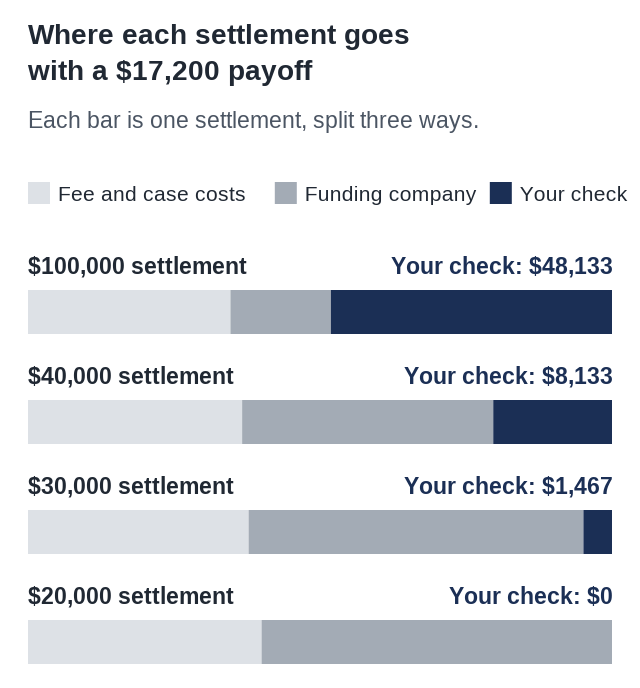
At $100,000, the payoff is a small slice and you keep $48,133. As the settlement gets smaller, your lawyer's fee gets smaller with it, but the $17,200 payoff does not. At $40,000 it takes more than two-thirds of what is left after the fee and costs, and your check is $8,133. At $30,000 your check is $1,467. At $20,000 there is nothing left for you.
In the table, each row is one settlement: what your lawyer's fee and case costs take first, what the funding company is paid next, and what is left for you.
| Settlement | Lawyer's fee and case costs | Paid to the company | Your check |
|---|---|---|---|
| $100,000 | $34,667 | $17,200 | $48,133 |
| $40,000 | $14,667 | $17,200 | $8,133 |
| $30,000 | $11,333 | $17,200 | $1,467 |
| $20,000 | $8,000 | $12,000 | $0 |
The example uses a 3% monthly charge that does not compound, $2,000 in case costs, a one-third lawyer's fee figured after costs, and no medical paybacks. The rate is an illustration, not a quote from any company.
In the first three rows, the company is paid its full $17,200, because that is less than both New York's limit and what is left after the fee and costs. Now look at the last row. On a $20,000 settlement, New York's limit is $15,000, but only $12,000 is left after the fee and costs. The company takes the $12,000 and cannot collect the rest from you.
A low settlement can leave you with no check
The rule that you never owe more than your case produces protects your savings and your paycheck. It does not protect your share of the settlement. In the last row of the table, you owe nothing more, and you also receive nothing more. The advance you already spent is all you get from the case.
So when a low offer arrives, ask your lawyer two questions before you answer it:
- What would my check be at this number, after the fee, the costs, the paybacks and the advance?
- Will the funding company accept less than the full payoff?
The second question is worth asking. In the same study, the company ended up with less than it was owed in about half of finished cases.
Whether to accept an offer is up to you and your lawyer. New York's law bars a funding company from influencing that decision. For more on that choice, see SettleScore's guide to whether it is better to sue or settle.
When the protection does not apply
- You break the contract or commit fraud. You can be held responsible if you break an important term of the contract, commit fraud against the company, or lie to it about something important. Be accurate on your application, and tell the company how your case ended.
- You change lawyers. Hiring a new lawyer does not cancel the contract. It stays valid.
- The law does not cover your advance. The Act covers you if you live in New York, your case is or will be filed in a New York court, the advance is $500,000 or less, and you signed on or after June 17, 2026. If any of those is missing, your contract decides what you owe. Nolo reports that most companies still take the loss when a case fails, but a minority may require repayment. Contracts call the safer kind "non-recourse," which means the company can collect only from your case. Ask your lawyer to confirm that yours says so.
Check the low-settlement numbers before you sign
Under New York's law, your contract must include a payment schedule that shows what you would owe under different outcomes. Ask your lawyer for the lowest settlement that is realistic for your case, find the closest row, and work out your check from there. SettleScore's settlement calculator does that math.
These guides go further: Who Gets Paid First in a Personal Injury Settlement? · How Much of a $50,000 or $60,000 Settlement Will I Get? · How to Compare Lawsuit Cash Advance Offers
This article is general information about New York law, not legal advice for your situation.
Sources: New York State Department of Financial Services, Litigation Funding · Ronen Avraham and Anthony Sebok, An Empirical Investigation of Third Party Consumer Litigant Funding, 104 Cornell Law Review 1133 (2019) · Nolo, Is a Pre-Settlement Loan a Good Idea for Cash-Strapped Injury Claimants? · New York Financial Services Law § 1001 · § 1002 · § 1003 · § 1004 · § 1005 · § 1007. Figures in the chart and table were calculated by CompareFunders from the stated example.